Helping Crops Stay Healthy

Imagine being sick, running a fever every day. You’d probably take some medicine to feel better. For crops such as soybeans and corn, pesticides such as insecticides, herbicides and fungicides are like medicine, helping them survive whatever Mother Nature throws at them. Every summer in the scorching heat, crops fight for survival. With the aid of these safety-tested chemicals, crops can grow healthier and produce higher yields.
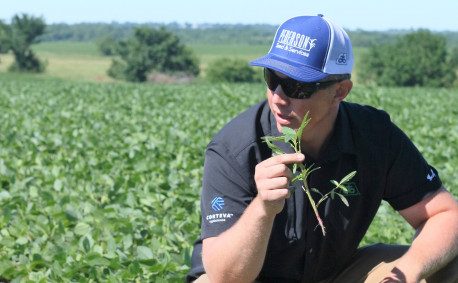
Brice Bunck is a senior agronomist with J.R. Simplot. His mission is simple: to help farmers achieve maximum yields. Brice notes he would not be as successful without the help of pesticides. His territory covers eastern Kansas, eastern Nebraska, Iowa and Missouri, where he spends the majority of his days testing new products to see if they can help farmers.
“There are a lot of products on the market that haven’t been tested in the fields,” Brice said. “My job is to test them and see if they will truly add value back to the farmer.”
Brice walks fields diagnosing pests, weeds and disease. He works closely with crop consultants to determine whether treatment is necessary and, if so, the appropriate protection for a given field.
A common misconception is farmers use excessive amounts of chemicals. Modern products are designed with specific application rates, which means only a certain amount is dispersed on a field. Brice emphasizes only the necessary amounts are used. Applying too much of a chemical can harm crops and soil and increase costs, as chemicals are expensive.
Contemporary chemicals also break down relatively quickly. Most pesticides have residual effectiveness of only 14 to 21 days. This means when they are applied, the chemicals are active for only a 14- to 21-day window.
Crop protection decisions must also account for the unpredictability of the weather. In a wetter year, fungicide may be necessary. Another growing season may offer weather conditions favorable to large pest populations.
“You can never outguess Mother Nature,” Brice said. “She is always changing, so we need the right tools to help us adapt.”
 Beyond the field, farmers must adjust to additional challenges. Many chemicals have been part of a national discussion about whether they are a risk to the food supply, environment or human health. What many people don’t know is these chemicals undergo rigorous testing and evaluation prior to approval for use, and such regulations help protect against those concerns. Farmers also must receive certification to apply chemicals and are required to go through testing and regulatory approval.
Brice not only communicates with farmers about what is best for their fields, but he also serves on the Kansas Soybean Association board, where he can bring concerns he hears from farmers to policymakers in Washington, D.C.
“We often talk about Mother Nature and continuing regulation that is under attack and how we can get the most yield out of our crop,” Brice said. “The products we use to maintain our productivity need to be protected.”
Brice may approach crop health from many angles, but he stays true to his end goal: to help farmers achieve maximum yields. Whether he is in the field working hands-on to diagnose a disease or lobbying in Washington to help protect the tools and applications that farmers use, Brice puts farmers first.
This article was written by Laci Kirchhoff, an intern with the Kansas Soybean Commission.
More About Agronomy on Kansas Farms
Meet more agronomists and see how this important science helps Kansas farmers.