Growing Hemp in Kansas

The hemp industry is new in Kansas, and if you’re curious about this crop, you’re not alone. Even crop scientist Melissa Nelson-Baldwin had reservations about it when her husband, Aaron, approached her about growing it on their farm south of Great Bend.
“I told him, ‘I don’t do drugs,’ and I don’t want to raise it,’” Melissa said. “Then he asked me to research how to grow industrial hemp and its uses. I’m a trained crop researcher so I began exploring it; it is very different from marijuana, and I became convinced we needed to start growing it.”
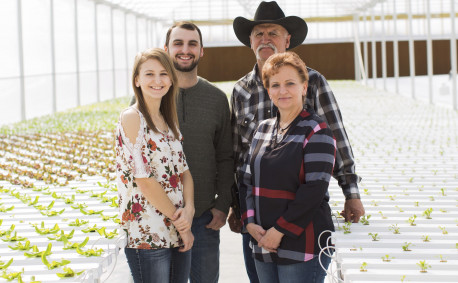
Melissa and Aaron, along with his brother, Richie, own a fourth-generation farm. Like other farms, they grow the standard crops of corn, wheat, soybeans and sorghum, along with raising cattle. South Bend Industrial Hemp is their pioneering venture into a new agricultural crop with great protentional and numerous challenges.
Now, almost three years after they planted their first crop, Melissa works to dispel myths about the hemp industry.
“To understand the difference between industrial hemp and marijuana, imagine walking into a grocery store to buy peppers,” Melissa said. “You can choose between jalapeño peppers and bell peppers. They are very different types of peppers, but they’re both considered peppers. It’s the same way with the cannabis industry. Cannabis is both hemp and marijuana, but those are two very different plants.”
One of the challenges of the hemp industry is its association with marijuana. Hemp cannot contain more than 0.3 percent of THC (Tetrahydrocannabinol, the psychoactive chemical in the plant associated with getting “high”).
“In 2019, Kansas opened the opportunity for farmers to grow industrial hemp,” Aaron said. “Wheat and corn prices were terrible then, and we wanted to be on the leading edge of a new crop. We were looking for another fiber and grain crop to help with cash flow.”
They planted 80 acres the first year and began learning how to use their traditional equipment to plant and harvest this new crop.
“We could have gone out and bought a million dollars’ worth of equipment to plant and harvest,” Aaron said. “But we were committed to using our planters, drills and combines and making the necessary adjustments. Richie has dialed in our equipment and works with other hemp farmers to fine tune their equipment, especially if it’s a different brand.”
Growing and Harvesting Hemp
Melissa explained that fiber and grain hemp is very similar to wheat with about a million plants per acre. The crop is also drought tolerant.
“Hemp uses about one-third the water as other crops,” she said. “It also pulls toxins and heavy metals out of the soil and the carbon capture of the plant is four times higher than others.”
 Once hemp is ready to harvest, it is unique from other crops in that it must be harvested twice. The first cutting – while the plant still has more than 80 percent moisture content – is to cut the top of the plant for the seeds. Since the plants can reach nearly 12 feet tall, the combine head is set to cut only the top of the plant.
Once the seed is harvested, the seven-foot-tall stalks are allowed to dry then cut with a swather and rolled into large, round bales.
Uses of Hemp
“There are two parts of the stalks that we use,” Aaron explained. “The bast and the hurd. The bast is the fibrous part of the stalks that are used for fibers in ropes, textiles, paper products, biofuels and plastics.”
The other part is the hurd, which is the woody, inner part of the hemp stalk. Hurd is used in non-woven items and other industrial applications like Hempcrete – a concrete-like building material that is much lighter. The pieces look like wood chips yet are much lighter and used in insulation and fiberboard. Due to their high absorbency rate, they are popular for animal bedding, mulch and chemical absorbent.
Finding a processing facility for hemp proved difficult at first for Melissa and Aaron, so they decided to build their own. Their plant is one of four in the United States.
Future Growth
To date, South Bend has sent their hurd and bast to various manufacturers in the U.S. and overseas to Australia. Currently, they are negotiating a deal with a company in Japan.
“This is such a new industry, each day is like research and development day,” Melissa said. “As society becomes more comfortable with it and sees the potential uses such as in single-use plastic, we know there’s a huge market. A plastic bottle made from hemp fiber is biodegradable and will break down in 80 days. That’s an immensely practical use.”
With that anticipated market in mind, South Bend is contracting with other farmers to grow hemp for them. Currently, nine farms in the area grow more than 1,600 acres of hemp, all of which is sent to their facility in Great Bend for processing.
Once Melissa understood the potential uses of this soil-friendly, renewable crop, she became an evangelist for the industry speaking to various groups across the U.S. and internationally. In addition, she, Aaron and Richie welcome groups for tours of the farm and processing plant.
“We had 40 state legislators out here recently,” Melissa said. “We also have an open house in July and this year we prepared for 250 but twice as many showed up.”
Melissa knows the industry is changing rapidly, but she is positioned to pivot and reignite her passion for growing hemp no matter what the next pitch will be.
“This industry is changing so rapidly, and each day is an adaptation to the different curve balls thrown at us and new opportunities,” she said. “But it is so exciting to be able to help set industry standards, help manufacturers discover new uses and educate people about the value of hemp.”
To learn more, you can visit their website or follow them on Facebook and Instagram.
This article by Rick McNary was shared in partnership with Kansas Living and edited for our website. Read the full, original article here.
More Unusual Kansas Crops